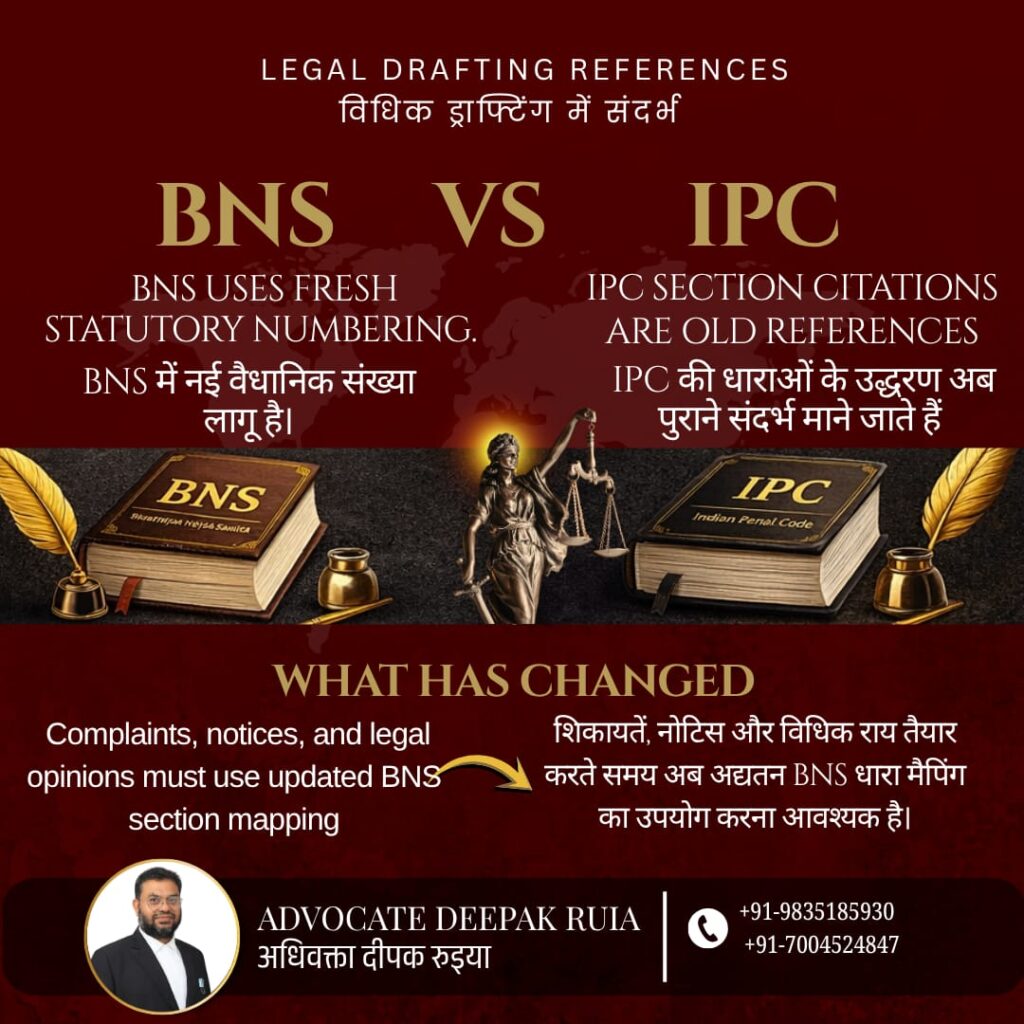

India’s criminal law system has entered a new legislative era with the replacement of the Indian Penal Code (IPC), 1860 by the Bharatiya Nyaya Sanhita (BNS). Alongside this transition, legal professionals, law firms, police authorities, compliance teams, and corporate legal departments must adapt their drafting practices to align with the updated statutory framework.
One of the most critical changes involves the shift from old IPC section references to the newly numbered provisions under BNS.
This is not merely a cosmetic change in numbering. It directly affects the accuracy, legality, and professional validity of legal drafting.
Why IPC References Are No Longer Sufficient
For decades, legal notices, complaints, FIR references, legal opinions, agreements, and court submissions relied heavily on IPC section citations.
Examples included:
- Section 420 IPC – Cheating
- Section 406 IPC – Criminal Breach of Trust
- Section 499 IPC – Defamation
- Section 376 IPC – Rape
With the implementation of BNS, many of these offences now exist under different section numbers, revised structures, or updated legal language.
As a result:
- Old IPC references may become outdated
- Drafting errors can create confusion
- Incorrect citations may weaken legal documents
- Courts and authorities increasingly expect BNS compliance
Legal drafting today must reflect the current statutory framework, not historical references.
What Has Changed Under BNS
1. Fresh Statutory Numbering
The biggest operational challenge is that BNS introduces completely new section numbering.
For example:
| IPC Section | Subject | Corresponding BNS Section |
|---|---|---|
| 420 IPC | Cheating | Different BNS numbering |
| 406 IPC | Criminal Breach of Trust | Renumbered |
| 499 IPC | Defamation | Reorganized |
| 302 IPC | Murder | Updated citation |
This means legal professionals cannot simply copy older templates anymore.
Every complaint, notice, or legal opinion must be reviewed for updated BNS references.
2. Structural Reorganization of Offences
BNS does not merely renumber provisions.
Several offences have been:
- Reclassified
- Consolidated
- Expanded
- Redefined
- Reorganized based on offence categories
As a result, relying solely on old IPC memory can lead to incorrect drafting.
For instance:
- Similar offences may now appear under grouped chapters
- Some definitions have evolved
- Certain procedural references now align differently with new criminal laws
This requires fresh legal interpretation rather than direct copy-paste conversion.
3. Legal Templates Need Immediate Updating
Most advocates, firms, and organizations use pre-drafted templates for:
- Legal notices
- FIR drafts
- Consumer complaints
- Employment disputes
- Corporate fraud matters
- Arbitration support documents
- Recovery notices
- Defamation communications
Many of these templates still contain IPC references.
Continuing to use outdated templates can:
- Reduce drafting credibility
- Create procedural objections
- Cause confusion before authorities
- Delay proceedings
Updating legal templates is now a professional necessity.
Areas Most Affected by the IPC to BNS Transition
Complaints and FIR Drafting
Police complaints and criminal allegations now require BNS references wherever applicable.
Incorrect citation can create:
- Administrative confusion
- Clarification requests
- Drafting delays
- Legal inconsistency
Legal Notices
Advocates issuing notices for:
- Fraud
- Criminal intimidation
- Defamation
- Misappropriation
- Breach of trust
must ensure that all statutory references align with BNS.
Corporate Legal Opinions
Companies seeking legal risk analysis now expect updated criminal law references.
Using obsolete IPC sections in:
- compliance opinions,
- investigation reports,
- forensic reviews,
- employee misconduct analysis,
can reflect outdated legal practice.
Court Filings and Legal Research
Junior associates, law interns, and litigation teams must revise:
- case notes,
- precedents,
- internal drafting databases,
- legal research repositories.
Future-ready legal drafting depends on accurate BNS integration.
Practical Challenges Legal Professionals Are Facing
1. Habitual Use of IPC Citations
Many lawyers have memorized IPC sections over years of practice.
The transition to BNS requires:
- retraining,
- statutory remapping,
- updated reference materials,
- drafting discipline.
2. Outdated Software and Templates
Many legal management systems and drafting software still auto-populate IPC references.
Organizations must now:
- update databases,
- revise automation workflows,
- reconfigure drafting templates.
3. Confusion in Parallel Usage
Since older judgments still refer to IPC provisions, professionals often need to:
- understand IPC precedents,
- interpret corresponding BNS provisions,
- explain mapping between both statutes.
This transitional phase requires careful legal analysis.
Best Practices for Legal Drafting Under BNS
Maintain an IPC-to-BNS Mapping Reference
Every legal office should maintain:
- updated comparison charts,
- quick-reference tables,
- drafting guides.
This reduces citation errors.
Audit Existing Templates
Review all:
- notices,
- agreements,
- complaint formats,
- legal opinion templates,
- internal SOPs.
Replace obsolete IPC references immediately.
Train Legal Teams
Law firms and corporate legal departments should conduct:
- drafting workshops,
- BNS interpretation sessions,
- legal update training programs.
Continuous education is essential during this transition period.
Verify Before Filing
Before issuing any legal document:
- cross-check section references,
- confirm updated statutory language,
- ensure alignment with current criminal laws.
Accuracy in drafting is now more important than ever.
Conclusion
The transition from IPC to BNS marks one of the most significant shifts in India’s criminal law framework in decades.
For legal professionals, the challenge is not only understanding the new law but also adapting everyday drafting practices to reflect the updated statutory structure.
Using outdated IPC references in modern legal drafting can create confusion, reduce professional accuracy, and weaken procedural clarity.
Whether drafting:
- complaints,
- legal notices,
- opinions,
- contracts,
- litigation documents,
the future of effective legal drafting now depends on proper BNS section mapping and updated legal referencing.
In modern legal practice, precision in statutory citation is no longer optional — it is essential.
Disclaimer: This blog is for general legal awareness only and should not be treated as legal advice. For any specific case, consult a qualified lawyer.
Check our other blogs –
Date of Applicability: BNS vs IPC — Why the Date of Offence Matters
Overview of Criminal Law: BNS vs IPC
Leave a Reply