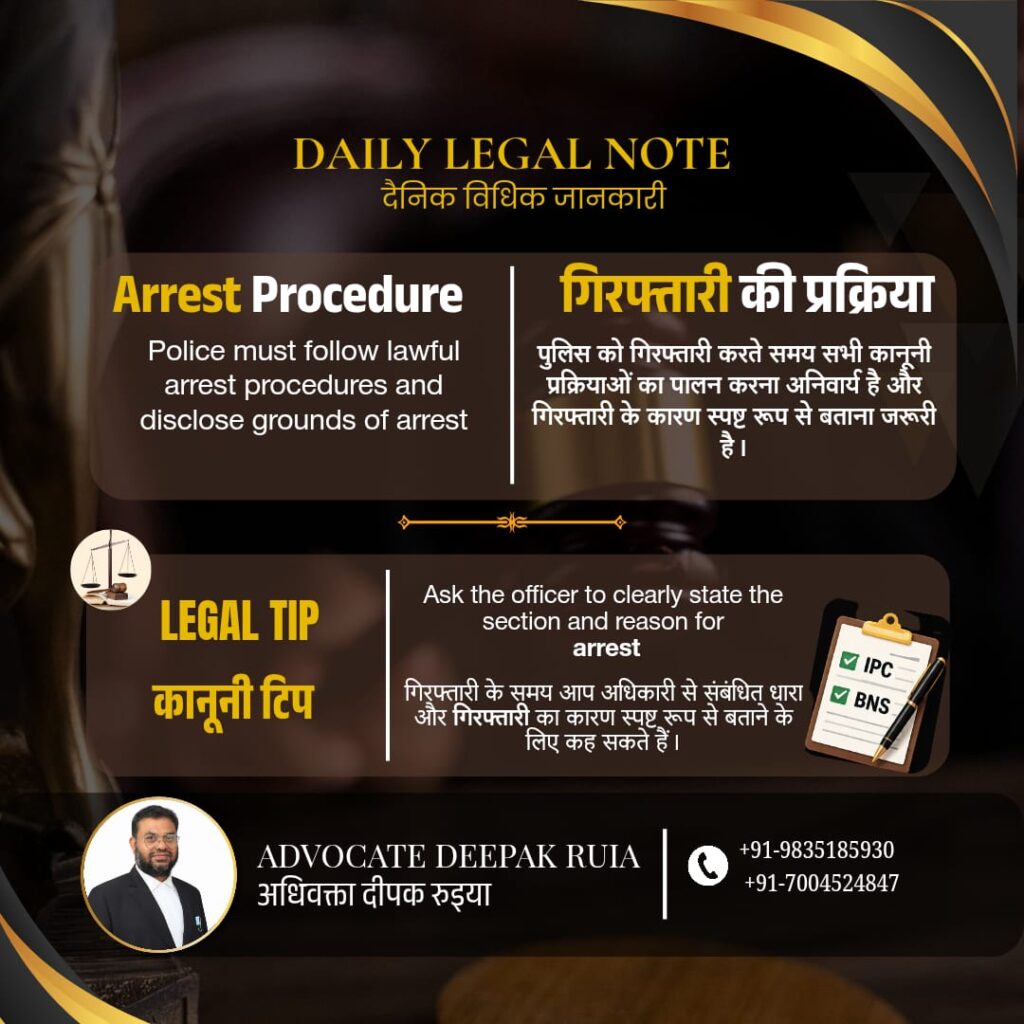

Arrest is one of the most serious actions taken under criminal law. However, Indian law provides important safeguards to ensure that arrests are carried out lawfully, fairly, and transparently.
Every citizen should understand their rights during an arrest, including the obligation of police authorities to disclose the grounds of arrest and follow proper legal procedures.
Awareness of arrest procedures can help individuals protect their legal rights and prevent misuse of authority.
What is an Arrest?
An arrest occurs when a person is taken into police custody under lawful authority in connection with an alleged offence.
Arrests may take place:
- During criminal investigations,
- Pursuant to warrants issued by courts,
- In cognizable offences where police possess arrest powers under law.
However, arrest powers are not unlimited and must be exercised according to legal procedure.
Legal Requirement for Lawful Arrest
Under Indian criminal law, police authorities are required to follow prescribed procedures while making an arrest.
This includes:
- Informing the individual about the grounds of arrest,
- Disclosing relevant legal provisions,
- Following procedural safeguards,
- Respecting constitutional and legal rights of the arrested person.
Failure to comply with lawful arrest procedures may result in legal consequences and challenges before courts.
Key Rights During Arrest
1. Right to Know the Grounds of Arrest
One of the most important legal rights is the right to be informed about:
- Why the arrest is being made,
- The alleged offence,
- The relevant legal sections involved.
Police officers are generally required to clearly communicate the grounds of arrest to the individual being arrested.
2. Right to Ask About the Relevant Section
The arrested person may ask:
- Which legal section is being invoked,
- Whether the offence falls under IPC, BNS, or other laws,
- The nature of allegations involved.
This becomes especially important after the implementation of the Bharatiya Nyaya Sanhita (BNS) replacing IPC.
3. Right to Inform Family or Legal Representative
An arrested person generally has the right to inform:
- Family members,
- Friends,
- Legal counsel or advocate,
about the arrest and place of detention according to applicable legal safeguards.
4. Right to Legal Representation
An arrested individual has the right to consult and seek assistance from a legal practitioner.
Early legal advice can help protect legal rights during:
- Investigation,
- Bail proceedings,
- Statements,
- Documentation,
- Court appearances.
5. Right Against Unlawful Detention
Police authorities must follow lawful procedures regarding:
- Arrest documentation,
- Custody duration,
- Production before appropriate judicial authority within the legally prescribed period.
Arbitrary or unlawful detention is prohibited under law.
Legal Tip for the Public
Always ask the police officer to clearly state:
- The reason for arrest,
- The applicable legal section,
- The nature of allegations involved.
Understanding the grounds of arrest is essential for protecting your legal rights and seeking appropriate legal assistance.
Remain calm, cooperate lawfully, and avoid obstructing official procedures while ensuring your legal rights are respected.
Importance of Legal Awareness After BNS Implementation
With the introduction of:
- Bharatiya Nyaya Sanhita (BNS),
- Bharatiya Nagarik Suraksha Sanhita (BNSS),
- Bharatiya Sakshya Adhiniyam (BSA),
India’s criminal law framework has undergone significant changes.
As section numbers and procedural provisions have changed, citizens and legal professionals must carefully verify:
- Applicable legal provisions,
- Arrest procedures,
- Rights during investigation,
- New criminal law terminology.
Common Mistakes People Should Avoid During Arrest Situations
1. Panicking or Resisting Arrest
Physical resistance may create additional legal complications.
2. Signing Documents Without Understanding
Always understand the contents of any document before signing.
3. Ignoring Legal Assistance
Consulting a qualified legal professional at the earliest stage can help safeguard legal rights.
4. Relying on Verbal Assurances Alone
Always seek clarity regarding:
- Legal sections,
- FIR details,
- Grounds of arrest,
- Case status.
Conclusion
Arrest procedures in India are governed by legal safeguards intended to balance investigation powers with individual rights.
Police authorities are required to follow lawful procedures and clearly disclose the grounds of arrest. Citizens should remain aware of their legal rights, including the right to know the applicable legal sections and reasons for detention.
Legal awareness is essential for ensuring fairness, accountability, and protection under the criminal justice system.
At Ruia Associates, we believe informed citizens are better equipped to protect their legal rights and navigate legal processes responsibly.
Disclaimer: This blog is for general legal awareness only and should not be treated as legal advice. For any specific case, consult a qualified lawyer.
Leave a Reply