
Legal Insights by Ruia Associates
A Stolen Document Can Steal Your Future
A lost Aadhaar card. A misplaced PAN. A photocopy handed over “just for verification” and never accounted for again. It sounds harmless — until that same document is used to open a fraudulent bank account, take out a loan in your name, or register a fake company. By the time you find out, the damage is already done, and the paper trail leads back to you.
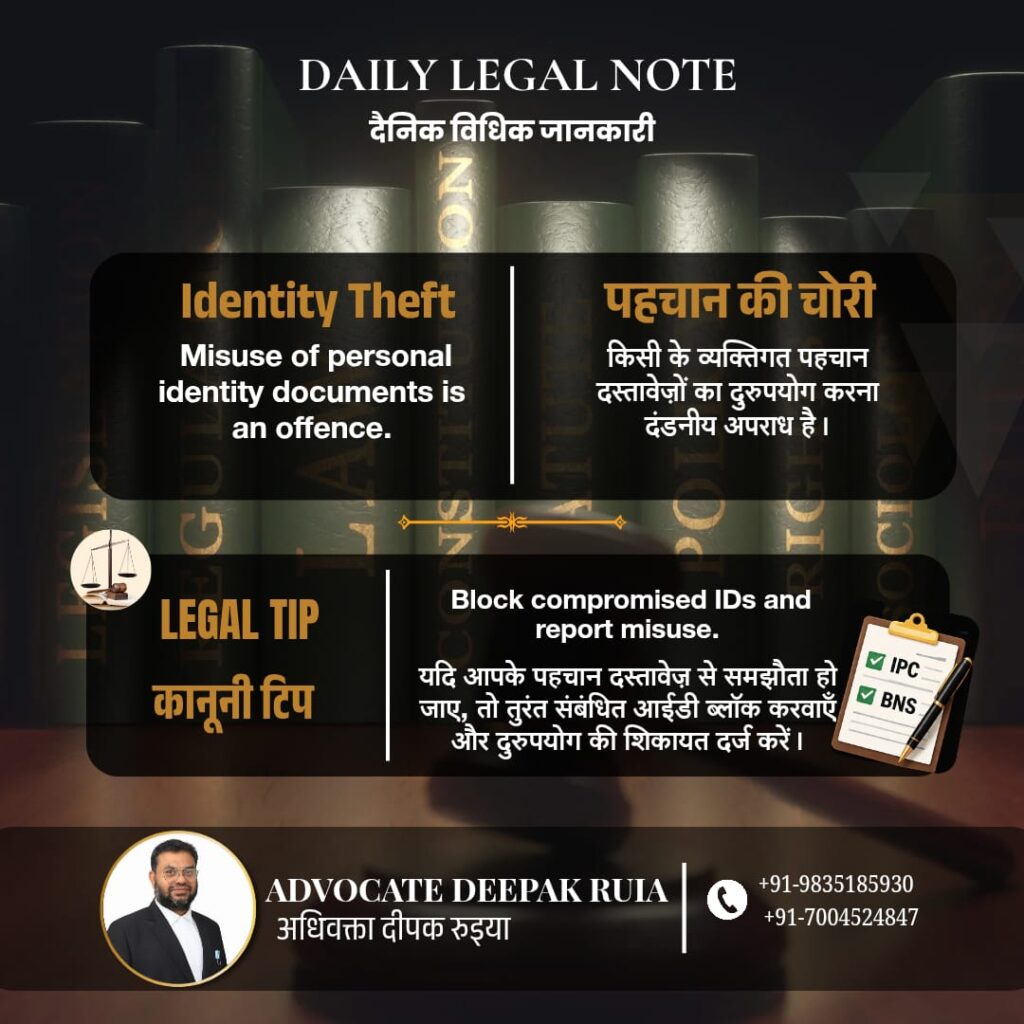
Identity theft isn’t just a cybercrime headline. It’s a fast-growing legal reality — and Indian law treats it as a serious, punishable offence.
The Legal Position: Misuse of Identity Is a Crime, Not a Loophole
Under Indian law, using someone else’s identity documents — whether to deceive, defraud, or impersonate — attracts direct criminal liability:
- Information Technology Act, 2000 — Section 66C: Punishes identity theft involving fraudulent or dishonest use of another person’s electronic signature, password, or unique identification feature, with imprisonment up to 3 years and a fine up to ₹1 lakh.
- Information Technology Act, 2000 — Section 66D: Covers cheating by personation using computer resources — the digital equivalent of pretending to be someone else to gain a benefit.
- Bharatiya Nyaya Sanhita, 2023 (replacing the IPC): Provisions on forgery, cheating, and personation apply squarely to the misuse of physical identity documents such as PAN cards, passports, and Aadhaar.
- Aadhaar Act, 2016: Unauthorised use, disclosure, or fraudulent authentication of Aadhaar data carries its own dedicated penalties, separate from general IT law.
In short: whether the misuse happens online or on paper, the law does not treat it as a grey area. It is a punishable offence, and both the person committing the fraud and, in certain cases, negligent custodians of data can face consequences.
Why This Matters More Than Ever
India’s push toward digital verification — e-KYC, instant loans, online account openings — has made identity documents more powerful and more exposed at the same time. A single compromised ID can be used to:
- Open bank accounts or credit lines fraudulently
- File false GST or tax returns
- Register SIM cards used in scams
- Execute property or loan fraud in your name
The person whose identity was stolen often bears the initial burden of proving they weren’t involved — a process that is avoidable with quick, decisive action.
Legal Tip for the Public: Act Immediately, Act on Record
If you suspect any of your identity documents have been lost, stolen, or misused, do not wait to “see if anything happens.” Take these steps immediately:
- Block the compromised ID — For Aadhaar, this can be done instantly via the UIDAI portal or helpline (1947). For PAN, cards, or bank-linked IDs, contact the issuing authority or bank without delay.
- File a formal complaint — Report the misuse at your nearest police station or via the National Cyber Crime Reporting Portal (cybercrime.gov.in). A First Information Report (FIR) or complaint acknowledgment creates a critical legal record.
- Notify relevant institutions — Inform your bank, employer, or any authority where the document may have been used, so alerts can be flagged on your record.
- Preserve evidence — Save screenshots, emails, SMS alerts, or any communication indicating misuse. This documentation is often decisive if the matter goes to court.
- Consult legal counsel early — A lawyer can help you file the right complaint, under the right provision, and protect you from being wrongly implicated in a crime you didn’t commit.
The Bottom Line
Identity theft isn’t a distant, abstract risk — it’s a documented, prosecutable offence under Indian law, and the window to protect yourself closes fast. Blocking a compromised ID and filing a report within hours, not weeks, is what separates a contained incident from a prolonged legal battle.
If you believe your identity documents have been compromised, or you’re facing the fallout of someone else’s misuse of your identity, Ruia Associates can help you navigate the legal process — from filing the right complaint to representing your interests if the matter escalates.
Protect your identity. Know your legal recourse. Act today.
Disclaimer: This article is for general informational purposes only and does not constitute legal advice. For guidance specific to your situation, please consult with Ruia Associates directly.
Leave a Reply