
Published by Ruia Associates | Legal Insights Blog
Introduction
Many people assume that a crime only occurs when someone is physically harmed. The truth, however, is far more nuanced under Indian law. A threat alone — even without any physical contact — can give rise to serious criminal liability. At Ruia Associates, we believe that an informed public is a protected public. This post breaks down what constitutes assault, how the law treats physical threats and force, and the critical first step every victim must take: seeking medical documentation.
What Is Assault Under Indian Law?
Under the Indian Penal Code (IPC), Section 351, assault is defined as any act or gesture made intentionally or knowingly that causes another person to apprehend that criminal force is about to be used against them. Crucially, actual physical contact is not required for an act to qualify as assault.
In simple terms:
- Raising a fist threateningly at someone
- Advancing aggressively toward a person with intent to intimidate
- Making a gesture that reasonably causes fear of imminent harm
…all of these can constitute assault in the eyes of the law.
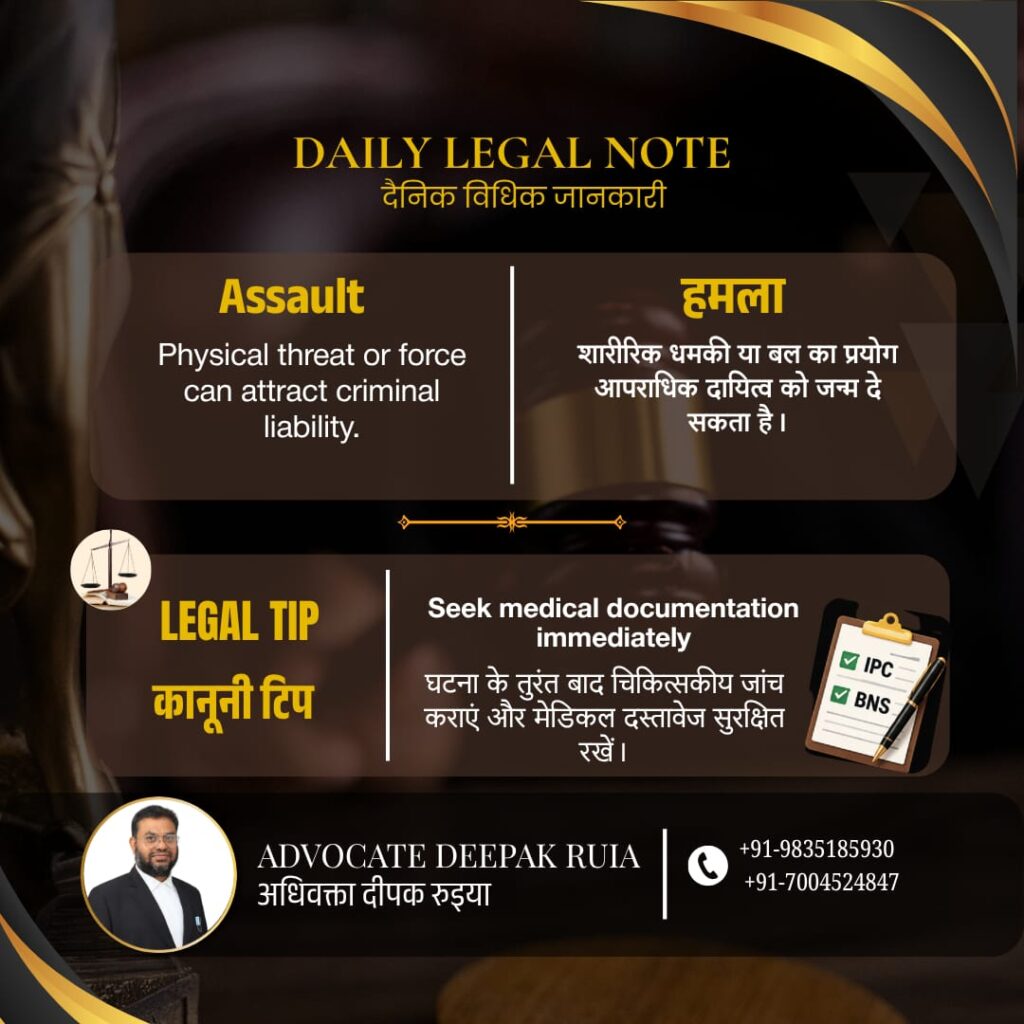
The Key Insight: Physical Threat or Force Can Attract Criminal Liability
This is where many victims — and even perpetrators — are mistaken. Indian criminal law draws a clear distinction:
| Act | Legal Classification |
|---|---|
| A threatening gesture causing apprehension of harm | Assault (Section 351 IPC) |
| Actual use of criminal force on a person | Use of Criminal Force (Section 350 IPC) |
| Both combined | Assault with Criminal Force |
The moment an individual intentionally places another in reasonable fear of imminent physical harm, the law is engaged. You do not need to wait until you are struck to have a valid legal claim.
What Constitutes “Criminal Force”?
Section 350 of the IPC defines criminal force as the intentional use of force on another person without consent, with the intent to cause injury, fear, or annoyance. This includes:
- Pushing or shoving
- Grabbing or restraining
- Throwing objects at someone
- Using a weapon to threaten at close range
Aggravated Forms of Assault
The law also provides for aggravated penalties when assault is committed under specific circumstances:
- Section 352 IPC — Punishment for assault or criminal force (up to 3 months imprisonment and/or fine)
- Section 353 IPC — Assault on a public servant (up to 2 years)
- Section 354 IPC — Assault on a woman with intent to outrage her modesty (up to 2 years or more)
- Section 354A, 354B, 354C, 354D IPC — Specific offences against women including harassment, stalking, and voyeurism
- Section 357 IPC — Assault with intent to wrongfully confine a person
Legal Tip: Seek Medical Documentation Immediately
If you have been assaulted or subjected to criminal force, the single most important step you can take immediately after the incident is to seek medical attention and obtain proper documentation.
Why Medical Documentation Matters
Medical records serve as critical evidence in both criminal and civil proceedings. Here is why you must not delay:
1. Establishes the Fact of Injury A Medico-Legal Certificate (MLC) issued by a registered medical practitioner records the nature, extent, and likely cause of injuries. This document is admissible in court and forms the backbone of any assault case.
2. Creates a Time-Stamped Record The sooner you seek medical attention, the closer the documentation is to the actual incident. Delayed documentation can be challenged by the defence as inconsistent or fabricated.
3. Supports Your FIR When filing a First Information Report (FIR) at the police station, presenting an MLC alongside your complaint significantly strengthens the police’s obligation to register and investigate the case.
4. Relevant Even When Injuries Appear Minor Even if you feel “fine” after a threatening confrontation or minor altercation, underlying injuries such as soft tissue damage, concussion, or psychological trauma may only become apparent later. A contemporaneous medical examination protects your interests.
5. Vital in Cases of Domestic Violence In domestic assault matters under the Protection of Women from Domestic Violence Act, 2005, medical documentation is often the most objective evidence available and carries significant weight before the Magistrate.
What to Do Step by Step
- Go to the nearest government hospital or registered clinic — Government hospital MLCs carry strong evidentiary weight.
- Inform the doctor that you are a victim of assault — The doctor is legally obligated to prepare an MLC.
- Do not wash, change clothes, or clean wounds before the examination where possible — this preserves forensic evidence.
- Keep copies of all medical records, prescriptions, and bills.
- File an FIR at the nearest police station — You can also file a complaint before the Judicial Magistrate directly under Section 190 of the CrPC if the police refuse to register your FIR.
- Consult a criminal lawyer immediately — Legal counsel ensures your rights are protected at every stage.
Can You File a Civil Suit for Assault?
Yes. Apart from criminal proceedings, a victim of assault may also pursue a civil action for damages under the law of torts. This allows you to claim monetary compensation for:
- Physical pain and suffering
- Medical expenses
- Loss of earnings
- Psychological trauma and mental anguish
A civil suit can run parallel to or independent of criminal proceedings, and both avenues should be explored with your legal counsel.
How Ruia Associates Can Help
At Ruia Associates, our team of experienced criminal and civil litigation attorneys is equipped to guide you through every stage of an assault matter — from filing your FIR and attending police proceedings to representing you before the Sessions Court or High Court.
We understand that confronting a perpetrator in the legal system can feel daunting. Our role is to ensure that the law works for you — swiftly, effectively, and with dignity.
Whether you are a victim seeking justice or an accused seeking a fair defence, we are here to help.
Conclusion
Physical threats and force are not trivial matters — they are criminal acts that the law takes seriously. Understanding your rights is the first step toward protecting yourself and your loved ones. If you or someone you know has been subjected to assault or criminal force, do not wait. Seek medical documentation immediately, file a complaint, and consult a qualified legal professional.
The law is your shield. Let Ruia Associates help you wield it.
Disclaimer: This blog post is intended for general informational purposes only and does not constitute legal advice. For advice specific to your situation, please consult a qualified lawyer.
Contact Ruia Associates for a confidential legal consultation.
Leave a Reply