
By Ruia Associates
When a physical altercation results in injury, one of the first legal questions that arises is deceptively simple: how serious was the harm? The answer is far from academic. Under Indian criminal law, the severity of an injury directly determines the section under which a case is registered, whether the offence is bailable, who tries it, and how many years of imprisonment an accused may face.
With the Bharatiya Nyaya Sanhita, 2023 (BNS) replacing the Indian Penal Code, 1860, the distinction between “hurt” and “grievous hurt” continues to sit at the heart of bodily-injury offences. At Ruia Associates, we frequently see how this single classification can change the entire trajectory of a case. This article breaks down the difference, the punishments, and one practical step that can protect your interests whether you are a victim or wrongly accused.
What the Law Means by “Hurt”
Under the BNS, hurt refers to bodily pain, disease, or infirmity caused to a person. It covers the lower end of the injury spectrum: bruises, minor cuts, temporary pain, and similar harm that does not leave lasting damage.
Voluntarily causing hurt is generally treated as a minor offence. A person is punishable with imprisonment up to one year, or a fine up to ₹10,000, or both. Because of its relatively low gravity, this offence is usually bailable and non-cognizable unless aggravating circumstances are present. Legal Bites
What Makes an Injury “Grievous”
Grievous hurt is a far more serious, and importantly, a precisely defined legal category. The law does not leave it to interpretation. The following kinds of hurt only are designated as grievous: emasculation; permanent loss of sight of either eye; permanent loss of hearing of either ear; loss of any member or joint; destruction or permanent impairing of the powers of any member or joint; permanent disfiguration of the head or face; fracture or dislocation of a bone or tooth; and any hurt which endangers life or which causes the sufferer to be in severe bodily pain for fifteen days or more, or unable to follow ordinary pursuits during that period. Lawrato
If an injury does not fall within one of these specific clauses, it cannot be charged as grievous hurt, no matter how painful it may have seemed at the time.
The consequences are correspondingly severe. The punishment for voluntarily causing grievous hurt may include imprisonment of up to seven years along with a fine, depending on the gravity of the offence. Legallyin
When Weapons or Dangerous Means Are Involved
The law treats injuries caused by dangerous weapons or harmful substances even more strictly. Offences relating to causing hurt or grievous hurt using dangerous weapons or harmful means—such as guns, knives, fire, poison, or explosives—carry enhanced penalties and, in the case of grievous hurt, a mandatory minimum sentence. These offences are non-bailable, reflecting how seriously the law views the use of dangerous means. Testbook
The Core Distinction at a Glance
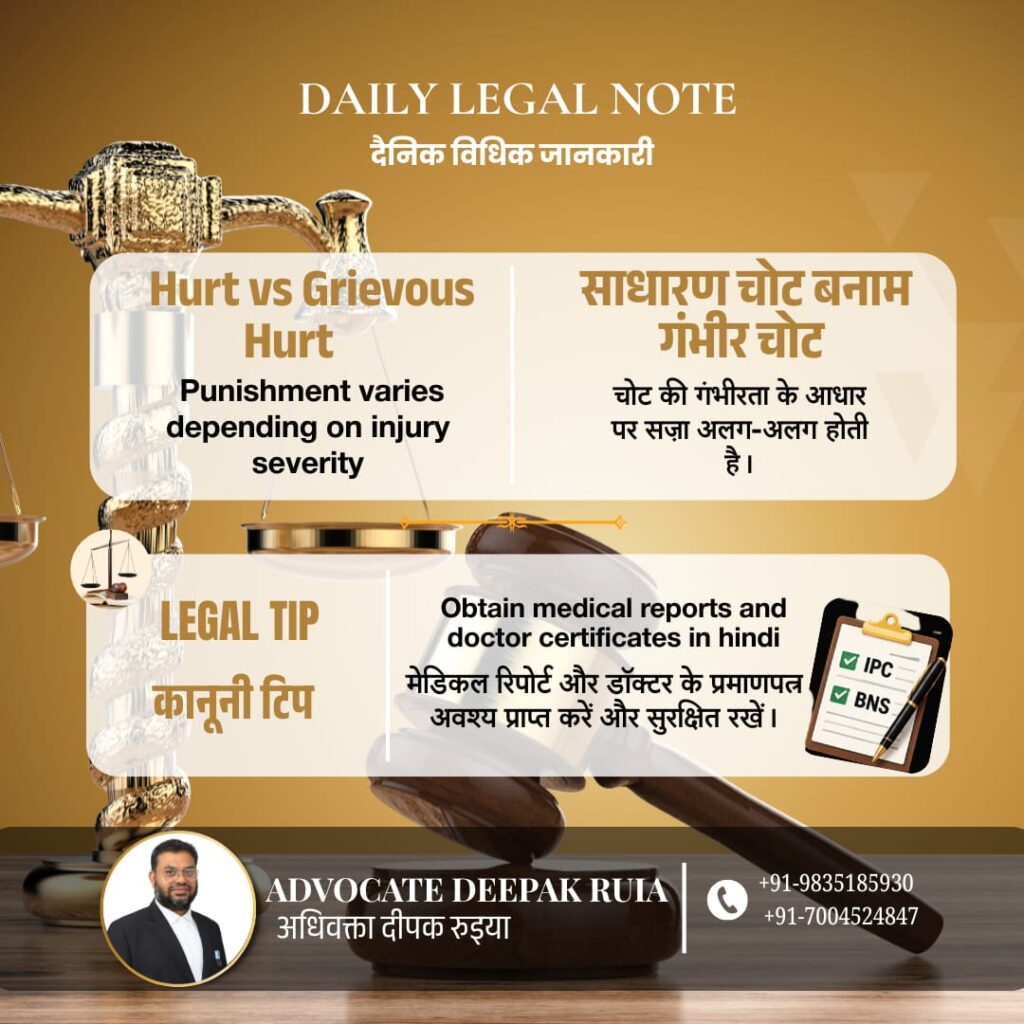
The fundamental principle is straightforward: the gravity of the injury drives the gravity of the punishment. Minor harm attracts a lighter, often bailable charge with a maximum of one year. Serious, life-altering, or permanent harm falls into the grievous category, exposing the accused to up to seven years, or more where weapons are involved. Everything turns on which side of that line the injury sits.
The Legal Tip That Can Make or Break a Case: Secure Medical Evidence
Here is the single most important piece of practical advice we offer the public on these matters: obtain medical reports and doctor certificates without delay.
Because the law defines grievous hurt by specific medical outcomes—a fracture, loss of vision, fifteen days of incapacity, and so on—the medical record is very often the deciding piece of evidence. A properly documented injury report does several things at once. For a victim, it establishes that the harm genuinely meets the grievous-hurt threshold, ensuring the offence is charged correctly rather than downgraded. For someone wrongly accused, the same evidence can demonstrate that the injury does not satisfy any clause of the grievous-hurt definition, potentially reducing the charge or weakening the prosecution’s case entirely.
We strongly recommend the following practical steps: seek medical attention immediately after any injury; ensure the treating doctor records the nature, cause, and extent of the harm; preserve all certificates, X-rays, scans, and prescriptions; and note the duration of any incapacity, since the fifteen-day standard is often decisive. Contemporaneous medical documentation carries far more weight than an account reconstructed weeks later.
How Ruia Associates Can Help
The line between hurt and grievous hurt is where many criminal cases are won or lost. Whether you are pursuing justice as a victim or defending against a charge that overstates your conduct, the right legal strategy begins with a correct reading of the injury, the evidence, and the applicable section. Our team at Ruia Associates advises clients on charge classification, medical-evidence assessment, bail applications, and trial defence in matters involving bodily-injury offences.
If you or someone you know is facing such a situation, reach out to us for guidance tailored to the specific facts of your case.
This article is for general informational purposes and does not constitute legal advice. Please consult a qualified advocate regarding your specific circumstances.
Leave a Reply