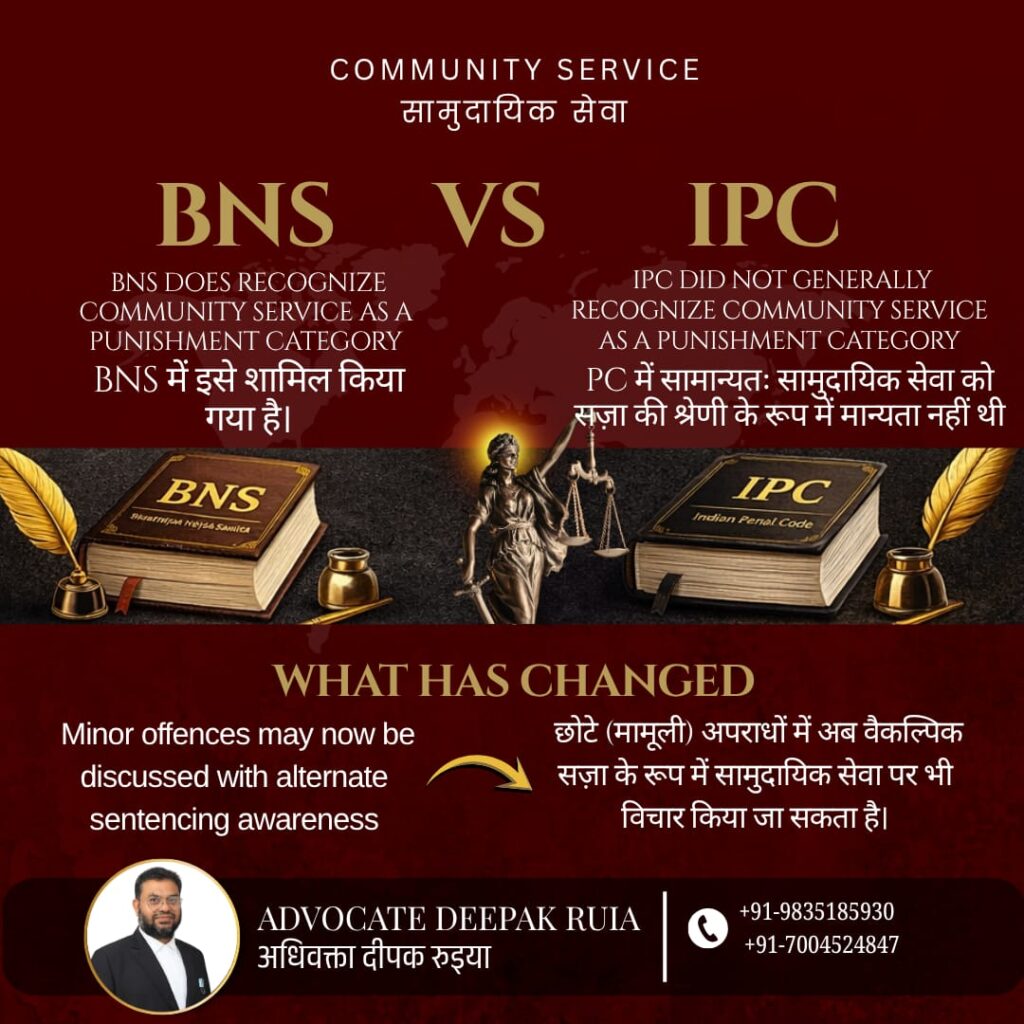

Community Service Under BNS vs IPC: What Has Changed?
India’s criminal justice system has undergone a major transformation with the introduction of the Bharatiya Nyaya Sanhita, 2023 (BNS), replacing the long-standing Indian Penal Code, 1860 (IPC). One of the most notable reforms introduced by BNS is the recognition of community service as a form of punishment for certain minor offences.
This change reflects a modern and reformative approach to criminal justice, focusing not only on punishment but also on rehabilitation and social responsibility.
Understanding Community Service
Community service is a form of punishment where an offender is required to perform unpaid work that benefits society. Instead of imposing imprisonment or monetary penalties in every case, courts may direct offenders to engage in socially useful activities.
Examples may include:
- Cleaning public spaces
- Assisting in community welfare programs
- Participating in environmental initiatives
- Supporting public institutions or local civic projects
The objective is to encourage accountability while allowing offenders to contribute positively to society.
Position Under the Indian Penal Code (IPC)
The IPC primarily recognized the following punishments:
- Death penalty
- Imprisonment for life
- Rigorous imprisonment
- Simple imprisonment
- Forfeiture of property
- Fine
There was no general statutory recognition of community service as a punishment category under IPC. Courts occasionally adopted innovative approaches in specific cases, but there was no structured legal provision making community service an independent form of sentencing.
As a result, even minor offences often resulted in fines or imprisonment, with limited focus on rehabilitation.
Community Service Under Bharatiya Nyaya Sanhita (BNS)
The Bharatiya Nyaya Sanhita introduces community service as a recognized punishment for specific minor offences.
This represents a shift toward:
- Reformative justice
- Restorative justice
- Reduced burden on prisons
- Greater social accountability
- Constructive rehabilitation of offenders
Instead of treating every violation with incarceration, courts now have greater flexibility to impose punishments that benefit both society and the offender’s rehabilitation process.
Why This Change Matters
1. Encourages Rehabilitation
Community service allows offenders to understand the impact of their actions while contributing positively to society. It promotes behavioural correction rather than mere punishment.
2. Reduces Overcrowding in Prisons
Indian prisons often face overcrowding issues. Community service offers an effective alternative for dealing with less serious offences, reducing pressure on correctional facilities.
3. Promotes Social Responsibility
Offenders actively engage in activities that improve public welfare, helping them reconnect with the community and develop a sense of responsibility.
4. Cost-Effective Justice
Community service reduces the financial burden associated with incarceration while still ensuring accountability for unlawful conduct.
5. Aligns with Modern Criminal Justice Practices
Many countries across the world already use community service as a recognized sentencing option. The BNS brings India’s criminal justice framework closer to globally accepted reformative practices.
Which Offences May Attract Community Service?
The BNS permits community service for certain minor offences as specifically provided under the law.
The exact applicability depends on:
- Nature of the offence
- Circumstances of the case
- Judicial discretion
- Statutory provisions governing the offence
Not every offence qualifies for community service. Serious crimes involving violence, public safety threats, or grave criminal conduct generally continue to attract traditional punishments such as imprisonment and fines.
Impact on Individuals Facing Minor Charges
Persons accused of eligible minor offences may now have the possibility of receiving a community service sentence instead of incarceration.
However, this does not mean the offence becomes insignificant. A conviction can still have legal consequences, and courts will evaluate the facts and circumstances before deciding an appropriate sentence.
Legal advice remains essential to understand available options and potential outcomes under BNS.
Public Awareness and Legal Guidance
The introduction of community service highlights the evolving philosophy of India’s criminal justice system. Citizens should be aware that certain minor offences may now be addressed through alternative sentencing mechanisms designed to balance accountability with rehabilitation.
Understanding these changes is important for individuals, businesses, educational institutions, and community organizations navigating the transition from IPC to BNS.
How Ruia Associates Can Help
The transition from IPC to BNS has introduced several important legal changes that affect criminal proceedings, legal drafting, and sentencing practices.
At Ruia Associates, our legal professionals assist clients with:
- Criminal law consultation
- BNS compliance and interpretation
- Bail and anticipatory bail matters
- Criminal defence representation
- Legal notices and documentation
- Court proceedings and litigation support
If you have questions regarding community service provisions, criminal offences, or your rights under the Bharatiya Nyaya Sanhita, our team is available to provide professional legal guidance.
Disclaimer
This article is intended for informational purposes only and should not be considered legal advice. Legal outcomes depend on the facts of each case and applicable laws. For specific legal assistance, consult a qualified advocate.
Leave a Reply